David Ruccio
I often explain to students, when I’m teaching economic models, they have to look at what’s happening behind the blackboard—all the implicit mechanisms that allow the models to work as they do.
By the same token, we have to ask, what’s going on behind the unemployment headlines?
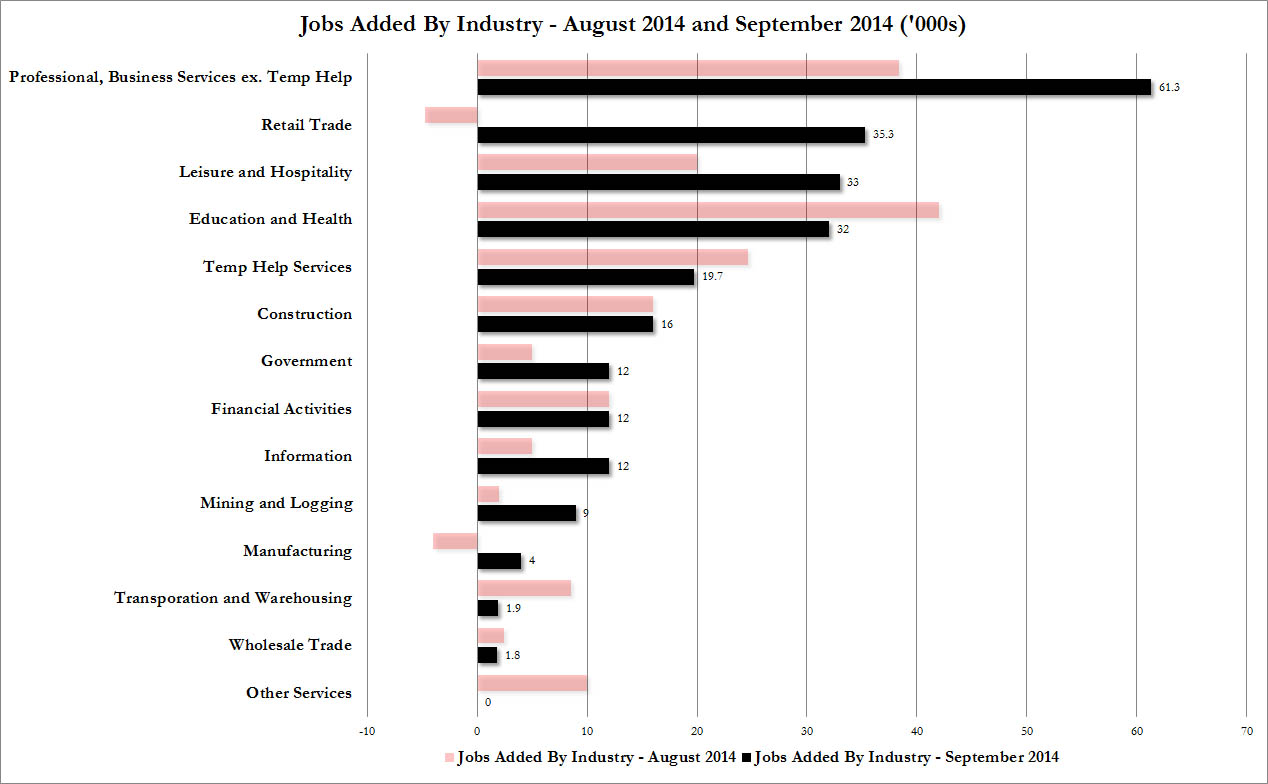
The headlines today all trumpet the number of new jobs added in September (248,000), such that the official unemployment rate fell for the first time since August 2008 to below 6 percent (5.9 percent, to be exact).
That’s good news. Employment is picking up. But, of course, that’s not the end of the story. And Tyler Durden helps us see why.

First, most of the new jobs (4 of the top 5 categories) were in retail trade, leisure and hospitality, education and health, and temp help.
So yes, America added a whole lot of minimum wage waiters, store clerks, groundskeepers and temps: truly the stuff New Normal “recoveries” are made of.

Second, the labor force participation rate dropped once again—from an already three decade low in August—to 62.7 percent. In other words, as against the 232,000 people who found jobs, the number of people not in the labor force rose to a new record high, increasing by 315,000 to 92.6 million!

And finally, even while new jobs are being created, hourly earnings are not moving at all (in fact, to be accurate, they actually declined by a penny from the $24.54 in August). In other words, real wages—accounting for inflation—continue to decline.
So, that’s what’s happening behind the triumphant unemployment headlines: the continued creation of lousy, low-paying jobs; the continued exit of hundreds of thousands of workers from the labor force; and the continued decline in real wages.
Anyone want to talk about the reserve army of labor?
The median net worth in the United States is, in real terms, lower today than it was in 1989.
from David Ruccio

The median net worth in the United States is, in real terms, lower today than it was in 1989.
As Matt O’Brien explains,
This is a story about stocks and houses. The middle class doesn’t have much of the former, which has rebounded sharply, but has lots of the latter, which hasn’t. Indeed, only 9.2 percent of the middle 20 percent of households owns stocks, versus almost half of the top 20 percent. So the middle class has not only missed out on getting a raise, but also on the big bull market the past five years.
The only thing they haven’t missed out on was the housing bust: 63 percent of that middle quintile own their homes, which are more likely to be a financial albatross than asset. And it doesn’t help that, with student loans hitting $1.2 trillion, people have to take out more and more debt just to try to stay in, or join, the middle class.